
ECGT Revisited
When ‘green’ is your brand’s identity, what can you still say?
The EU’s Empowering Consumers for the Green Transition rules apply from 27 September 2026. As businesses complete their final reviews, a difficult question is emerging: what happens when the claims that need changing are central to the brand itself?
In our recent client work, broad phrases such as “eco-friendly” have not always been the hardest issue. More often, the challenge has been a leaf-shaped badge, an in-house sustainability logo or a symbol that has appeared on packaging for years without anyone treating it as a formal label.
For brands built around an environmental ethos, removing these elements can feel like removing the reason customers choose them. The aim now is to decide which messages can be supported and retained, which need a different presentation, and where the brand may need to rethink how it expresses its values.
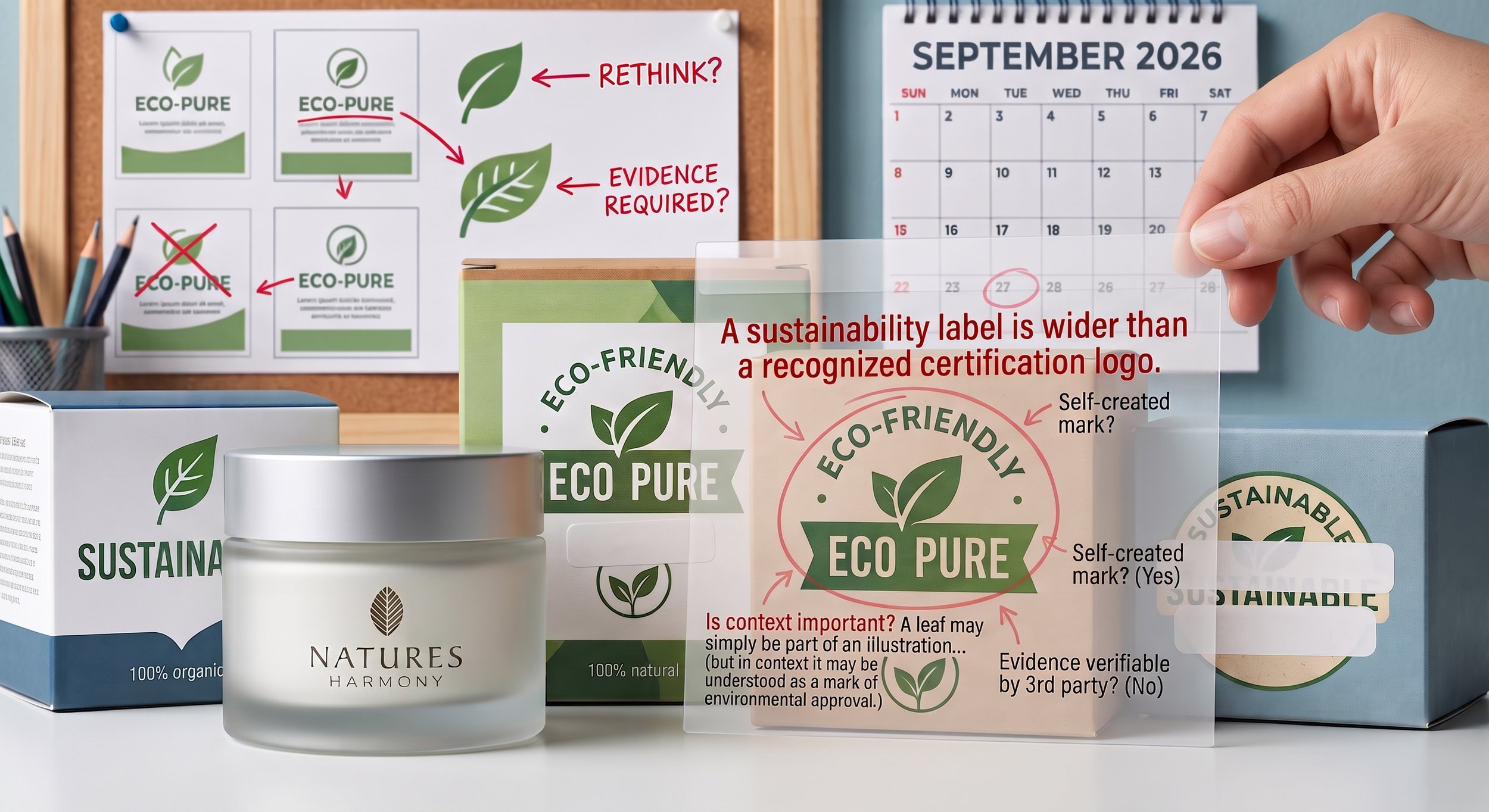
Could your artwork be a sustainability label?
A sustainability label is wider than a recognised certification logo. A voluntary mark that sets a product or business apart by suggesting an environmental or social benefit may fall within the rules, even if the brand created it itself.
That makes context important. A leaf may simply be part of an illustration. Put it in a badge beside words about natural ingredients or sustainability, and consumers may understand it as a mark of environmental approval. The European Commission’s recently updated Q&A specifically highlights this risk.
If a graphic is a sustainability label, the legal test is demanding: it must be established by a public authority or based on a certification scheme meeting the Directive’s conditions. A brand can own a scheme, but that scheme still needs, among other things, publicly available requirements and independent third-party verification and monitoring. Having evidence for the statement inside a badge does not, by itself, answer whether the badge is permitted.
Businesses should therefore review each mark as a consumer would see it on the finished pack, product page or advertisement. Ask what the mark appears to certify, who set its criteria and who independently checks continued compliance. If those questions cannot be answered, changing the graphic may be more realistic than trying to retain it.
Is qualifying a claim enough?
Adding a clear, prominent explanation on the same medium can mean that wording is no longer classed as a generic environmental claim. It does not automatically make the resulting message acceptable. The specific statement and the overall impression still need to be accurate and supported.
This is where cosmetic brands can encounter another difficulty. A claim may be carefully qualified to avoid suggesting that the whole product is “green”, but still leave consumers with an unsupported impression about the finished cosmetic or about other, legally used ingredients. For example, a factual statement about an ingredient’s origin should not be allowed to imply, without evidence, that the whole formula has a lower environmental impact or is safer than alternatives.
The cosmetic claims common criteria remain relevant alongside the new consumer rules. They address matters including truthfulness, evidence, honesty and fairness; the accompanying technical document explains why some “free from” claims can be problematic when they denigrate authorised ingredients. Whether a particular environmental or ingredient message crosses that line depends on its wording and presentation.
Our approach is to review the message in two stages: what exactly does the evidence establish, and what is a consumer likely to take from the complete presentation? A qualification is useful only if it brings those two answers together.
What if the strongest claims are your USP?
For some brands, this is a commercial issue as much as an artwork issue. A collection of claims about packaging components, sourcing practices and individual ingredients may be accurate, but it may no longer communicate the simple environmental promise on which the brand was built.
There is no easy wording fix for that gap. The decision is where the business wants to invest its distinctiveness. It could pursue a suitable certification scheme, strengthen evidence for a smaller number of meaningful product claims, or explain its practices through specific, verifiable information across packaging and digital channels. Those routes have different costs and timescales. A detailed sustainability page can provide valuable context, but it cannot repair a misleading impression created on the front of a pack.
Brands should also be willing to distinguish a genuine business commitment from a claim that every product has a particular environmental benefit. A company may have made substantial improvements without having evidence to support a broad claim across its entire range. Explaining a specific change honestly may be less dramatic, but it gives customers a reason to trust the story.
What should businesses decide now?
With the application date upon us, start with the messages that are most visible and hardest to defend:
Identify badges, seals and icons that consumers could read as environmental or social approval.
Check whether each label is backed by a qualifying scheme or established by a public authority.
Review any replacement wording against both its evidence and the overall presentation, including the cosmetic claims common criteria where relevant.
Update digital claims promptly and decide what practical changes are needed for packaging already in circulation.
Agree which environmental messages are important enough to justify further evidence, certification or a longer-term change to the brand’s positioning.
The Directive provides no general extension for existing sustainability labels. However, the Commission and national consumer authorities have recognised the practical difficulty of old packaging stock and described a proportionate, case-by-case approach to enforcement. Businesses should record the steps they take and their plan for correcting affected materials; they should not treat old stock as automatically exempt.
The hardest reviews may leave a brand with fewer claims in the short term. That is an honest commercial challenge, especially where environmental values are its USP. Bloom can help businesses decide which messages are worth retaining, what evidence or certification they would require, and how to communicate genuine progress without asking the claims to say more than the evidence supports.
Amanda Isom