
Microplastics: The Countdown to 2027
Navigating the EU REACH Microplastics Transition for Rinse-Off Cosmetics
The EU's REACH microplastics restriction (Regulation (EU) 2023/2055) is moving from a future concern to an immediate compliance priority. While many cosmetic businesses are aware of the legislation, the next major deadline on 17th October 2027 will have a direct impact on a wide range of rinse-off cosmetic products.
For manufacturers and brand owners, now is the time to review formulations, engage suppliers, and identify any materials that may fall within scope.
Why 2027 is A Critical Milestone
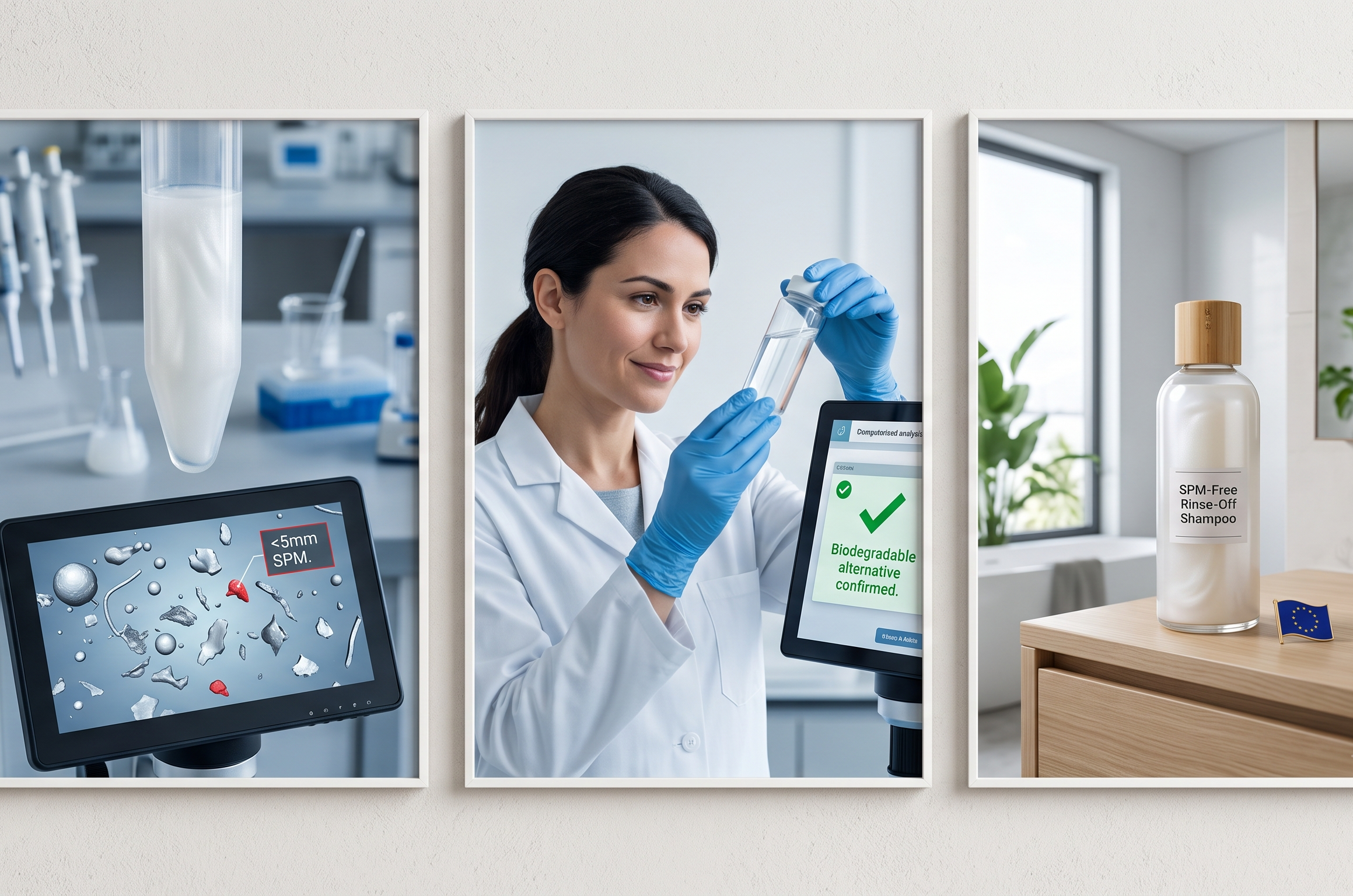
From 17th October 2027, rinse-off cosmetic products containing synthetic polymer microparticles (SPMs) above 0.1% can no longer be placed on the EU market.
This is the first major category deadline under the REACH restriction that will affect a significant number of everyday cosmetic formulations. Businesses that delay assessing their portfolios may face urgent reformulation projects, supply chain disruption, or restrictions on market access.
What Is a Rinse-Off Cosmetic Product?
Under Regulation (EC) No 1223/2009, a rinse-off cosmetic product is a cosmetic product which is intended to be removed after application on the skin, the hair or the mucous membranes. This category is wide-reaching, including shampoos, conditioners, shower gels, liquid soaps, and scrubs.
The Compliance Challenge: Beyond ‘Microbeads’
Many brands believe they have already achieved compliance by removing physical exfoliating beads. However, the REACH definition of synthetic polymer microparticles is significantly broader. It captures a vast range of synthetic polymers including many common thickeners, film-formers, and opacifiers.
As a reminder:
SPM definition:
Polymers that are solid and which fulfil both of the following conditions:
(a) are contained in particles and constitute at least 1 % by weight of those particles; or build a continuous surface coating on particles;
(b) at least 1 % by weight of the particles referred to in point (a) fulfil either of the following conditions:
(i) all dimensions of the particles are equal to or less than 5 mm;
(ii) the length of the particles is equal to or less than 15 mm and their length to diameter ratio is greater than 3.
The following polymers are excluded from this designation:
(a) polymers that are the result of a polymerisation process that has taken place in nature, independently of the process through which they have been extracted, which are not chemically modified substances;
(b) polymers that are degradable as proved in accordance with Appendix 15;
(c) polymers that have a solubility greater than 2 g/L as proved in accordance with Appendix 16;
(d) polymers that do not contain carbon atoms in their chemical structure
.
The legal definition is highly technical, and determining whether a material falls within scope often requires detailed information from suppliers regarding particle size, morphology, and physical form.
This makes ingredient-by-ingredient assessment essential.
Are There Any Exemptions?
The good news is the answer is ‘yes’! Not every polymer that falls within the SPM definition is prohibited. The Regulation provides a number of exemptions, including:
where synthetic polymer microparticles are contained by technical means so that releases to the environment are prevented when used in accordance with the instructions for use during the intended end use; (LABELLING REQUIRED*)
when the physical properties of the SPM are permanently modified during intended end use in such a way that the polymer no longer fits the definition
when the SPM is permanently incorporated into a solid matrix during intended end use.
* These should have been labelled by 17 October 2025 with instructions for use and disposal explaining to professional users and the general public how to prevent releases of synthetic polymer microparticles to the environment.
Immediate Action Items for Your Formulation Team
Conduct a portfolio audit: Identify every polymer or potential SPM in your rinse-off portfolio.
Engage your suppliers: Request supporting technical data from suppliers to determine whether the ingredient fits the SPM definition.
Verify compliance status: Where a material may qualify as an SPM, determine whether it benefits from an exemption or meets the biodegradability requirements set out in the legislation. Again, communication with your supply chain will be crucial here!
Plan reformulation early: If a material cannot meet the regulatory requirements, reformulation may be necessary. Starting early provides more time for ingredient screening, stability testing, efficacy validation, and regulatory review.
Looking Ahead
October 2027 may seem distant, but reformulation projects rarely happen overnight. Early assessment allows businesses to make informed decisions, avoid last-minute compliance risks, and maintain uninterrupted access to the EU market.
At Bloom, we are helping clients identify potentially impacted SPM, assess regulatory obligations, and develop practical compliance strategies for the upcoming REACH deadlines. Get in touch today to see how we can support your business to comply under the Microplastic restriction.
Laila Manshi