
Insights from In-Cosmetics Paris 2026
At the recent In-Cosmetics Paris event (15 April 2026), the regulatory landscape for cosmetic preservation was a focal point of technical discussion. Our CEO participated in a panel of industry experts to address the complexities of Regulation (EC) No 1223/2009 (and its UK equivalent) specifically regarding the classification of preservatives and the substantiation of related marketing claims.The roundtable included the Preserving Safely in a Green World: Science, Claims & Compliance topic, chaired by Barbara Brockway.
The following article outlines the core technical takeaways and regulatory interpretations discussed during the session.

1. The Legal Definition and "Primary Intent" of Preservatives
Under Article 2(1)(l) of the EU Cosmetics Regulation, preservatives are defined as substances "exclusively or mainly intended to inhibit the development of micro-organisms in the cosmetic product." This definition creates a distinct legal boundary for ingredients listed in Annex V (the Positive List).
Key Technical Implications:
Annex V Compliance: Any substance utilised with the primary intent of preservation must be explicitly listed in Annex V. Compliance requires adherence to specified maximum concentrations, product types (rinse-off vs. leave-on), and mandatory labelling requirements.
Multifunctional Ingredients: A critical area of discussion remains substances with dual functions—those possessing antimicrobial properties but added primarily for other technical purposes (e.g. solvent, humectant, or fragrance). These do not technically fall under Annex V, provided their primary function in the formula is not preservation.
Safety Substantiation: Regardless of an ingredient’s classification, the Responsible Person (RP) must ensure the safety of the specific concentration within the Cosmetic Product Safety Report (CPSR). Furthermore, effective preservation must be validated via Preservative Efficacy Testing (PET).
2. "Preservative-Free" Claims and Regulatory Scrutiny
The panel addressed the increasing scrutiny by national competent authorities—notably the DGCCRF in France—regarding "Preservative-Free" claims.
From a regulatory standpoint, if a product passes a Challenge Test solely due to the inclusion of a multifunctional ingredient, authorities may argue the ingredient’s de facto function is preservation. This triggers several compliance risks:
Misleading Claims: Under the EU Technical Document on Cosmetic Claims, a "Preservative-Free" claim may be considered true but not honest. If:
1. The claim implies a unique benefit when the product is actually being preserved by "hidden" or multifunctional ingredients; or
2. The product type does not normally contain preservatives so that the claim implies a unique benefit that is standard to all similar products.Trace Analysis: For a "Preservative-Free" claim to be robust, brands must also ensure no trace amounts of Annex V substances are introduced via raw material carry-over.
The "Self-Preserving" Framework: The panel noted that "Self-Preserving" is often a more defensible claim for formulations relying on physicochemical properties or multifunctional ingredients. However, it still requires thorough technical documentation to avoid being categorised as ambiguous or confusing to the end-user.
3. Low-Risk Products (ISO 29621:2017)
While much of the discussion focused on active preservation systems, for companies who wish to avoid preservatives and the grey area of multifunctional ingredients, at Bloom we recognise that some formulations may inherently be low-risk.
ISO 29621:2017 provides a standardised framework for identifying low-risk products. According to this standard, a "reasoned microbiological risk assessment" can justify the absence of preservatives based on specific product design features that do not support microbial growth:
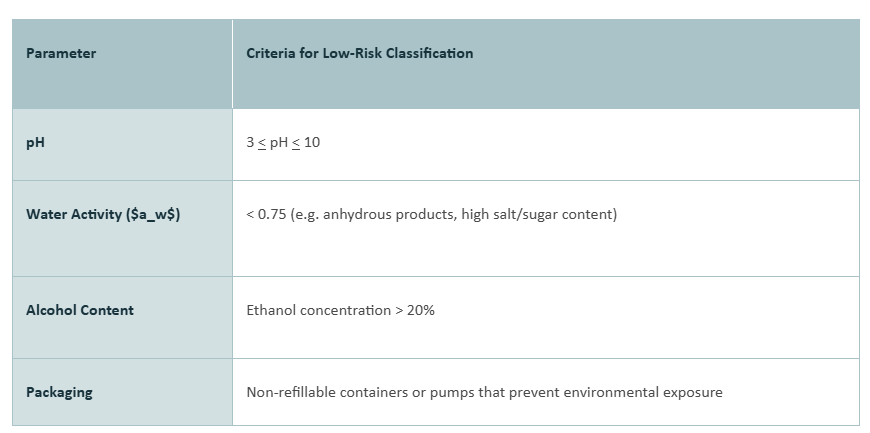
Utilising ISO 29621 allows the RP to provide a technical justification for omitting both Annex V preservatives and traditional challenge testing, provided the assessment is documented within the Product Information File (PIF).
The Future of Annex V
Despite the rise of innovative formulation designs and "self-preserving" systems, Annex V continues to hold value and remains useful as the primary and definitive reference for the most common and historically established preservatives used within the industry. It serves as a clear, legally defined list for these foundational substances.
If you need further support at Bloom Regulatory, we can help you navigate formula compliance and claims for your cosmetics range, so please do not hesitate to contact us.
Amanda Isom